


How Big Is the Hyundai Tucson? Dimensions and Space Explained
The 2026 Hyundai Tucson measures 182.7 inches long and 73.4 inches wide excluding the side mirrors, with a 108.5-inch wheelbase. It seats five and offers a roomy second row, while gas and hybrid versions provide up to 41.2 cubic feet of cargo space behind the rear seats.¹ ²
Those numbers put the Tucson in a useful spot for compact-SUV shoppers: substantial passenger and cargo room without stepping up to the footprint of a larger three-row SUV. That balance can matter when your week includes parking off University Avenue, family errands, commuting, and hauling the gear that tends to accumulate in an SUV.
2026 Hyundai Tucson Dimensions at a Glance
| Measurement | 2026 Hyundai Tucson |
| Length | 182.7 in. |
| Width, excluding mirrors | 73.4 in. |
| Wheelbase | 108.5 in. |
| Turning diameter | 38.6 ft. |
| Front legroom | 41.4 in. |
| Rear legroom, gas and hybrid | 41.3 in. |
| Rear legroom, plug-in hybrid | 39.5 in. |
| Gas passenger volume | 108.2 cu. ft. |
| Hybrid passenger volume | 107.9 cu. ft. |
| Plug-in Hybrid passenger volume | 105.9 cu. ft. |
Gas, hybrid, and plug-in hybrid Tucson models share the same basic 182.7-inch length, 73.4-inch body width, and 108.5-inch wheelbase.¹ ² ³ The important space differences show up primarily inside, especially when comparing rear legroom and cargo capacity.
Hyundai Tucson Length, Width, and Wheelbase
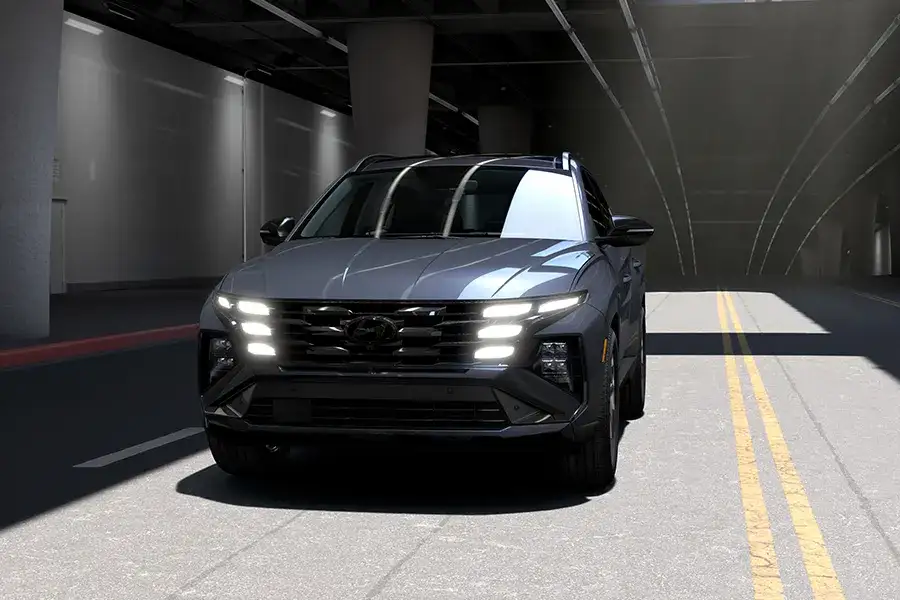
At about 15 feet, 3 inches long, the Tucson has the road presence and interior packaging expected from a modern compact SUV without becoming oversized for everyday use.¹
That matters in places where driving involves more than cruising on an open highway. A trip through the Broadway and Norwood Central area can include tighter parking spaces, station traffic, and frequent low-speed maneuvering. The Tucson’s 38.6-foot turning diameter is another useful dimension to consider when thinking about those everyday situations.¹
Its 73.4-inch width does not include the exterior mirrors. If you are checking a garage opening or another tight space at home, leave additional clearance rather than treating 73.4 inches as the Tucson’s total side-to-side requirement.
The 108.5-inch wheelbase also helps explain how the Tucson combines its manageable exterior footprint with meaningful passenger room inside.¹
Hyundai Tucson Interior Dimensions and Rear-Seat Space
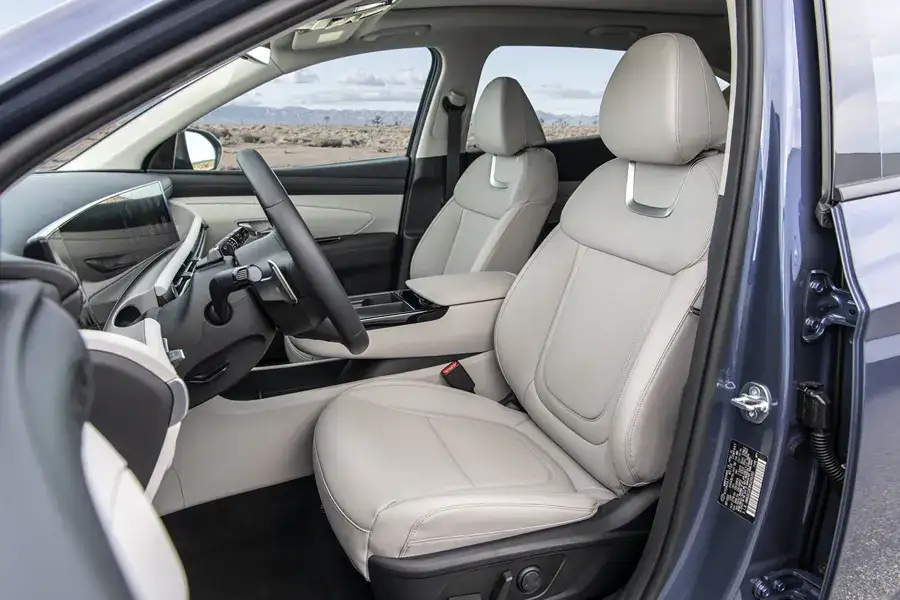
The gas-powered Tucson gives passengers 41.4 inches of front legroom and 41.3 inches in the rear. It also provides 57.6 inches of front shoulder room, 56.0 inches of rear shoulder room, 54.5 inches of front hip room, and 53.9 inches in the rear.¹
Those numbers make the second row more than an occasional-use space. It has useful room for adults, growing kids, and the everyday family routine. If the afternoon involves picking someone up near Prospect Street before heading to the next activity, having substantial rear legroom can be just as important as the amount of cargo space behind it.
The Tucson Hybrid closely follows the gas model for passenger room, including the same 41.4 inches of front legroom and 41.3 inches of rear legroom.²
The Tucson Plug-in Hybrid retains 41.4 inches up front, while rear legroom measures 39.5 inches.³ Shoppers considering the PHEV may want to spend extra time in the second row during a test drive, particularly if taller passengers or rear-facing child seats are part of the routine.
For young families, an in-person space check can be especially worthwhile. Bring the car seat, diaper bag, or stroller you actually use and see how easily everyone gets settled before the next afternoon at Father Mac’s.
How Much Cargo Space Does the Hyundai Tucson Have?
Cargo space varies more by powertrain than the exterior dimensions do.
| Tucson Version | Cargo Space Behind Rear Seats | Maximum Cargo Space With Rear Seats Folded |
| Gas Tucson | Up to 41.2 cu. ft. | Up to 80.3 cu. ft. |
| Tucson Hybrid | Up to 41.2 cu. ft. | Up to 80.0 cu. ft. |
| Tucson Plug-in Hybrid | 31.9 cu. ft. | Up to 71.8 cu. ft. |
The gas Tucson and Tucson Hybrid are especially close in cargo capacity.¹ ² Both provide up to 41.2 cubic feet behind the second row, giving shoppers interested in the Hybrid little sacrifice in maximum cargo room compared with the gas model.
That kind of space is useful when an ordinary Saturday means sports bags for Murphy Field, groceries, backpacks, or a stroller all competing for the same cargo area.
Folding the second row expands the usable area considerably. The gas Tucson reaches up to 80.3 cubic feet, while the Hybrid provides up to 80.0 cubic feet.¹ ² That added flexibility can come in handy for bulkier purchases, home-project supplies, or outdoor gear for a day at Borderland State Park.
The Tucson Plug-in Hybrid has a different interior packaging equation, with 31.9 cubic feet behind the rear seats and up to 71.8 cubic feet with them folded.³ If cargo room is a major priority, comparing the PHEV and Hybrid cargo areas in person can make the tradeoff much easier to judge.
Explore current Tucson Hybrid options or see Tucson Plug-in Hybrid options if you want to compare how the different powertrains package their passenger and cargo space.
Gas vs. Hybrid vs. Plug-In Hybrid Tucson Space
The three Tucson powertrains do not require choosing three dramatically different exterior sizes. Their basic footprints are the same. Where the decision becomes more meaningful is inside.
The gas Tucson offers 108.2 cubic feet of passenger volume, compared with 107.9 cubic feet in the Hybrid and 105.9 cubic feet in the Plug-in Hybrid.¹ ² ³
For many shoppers, that makes the gas-versus-Hybrid space decision particularly straightforward: passenger dimensions are extremely similar, and maximum cargo capacity differs by only a fraction of a cubic foot with the second row folded.
The PHEV gives up some rear-passenger and cargo space compared with the other two versions, which makes an in-person fit check especially useful.
That is the kind of difference worth testing with real life rather than numbers alone. If your week regularly involves passengers, activity bags, and stops around the Norwood Civic Center, load the Tucson the way you would actually use it.
Will a Hyundai Tucson Fit in Your Garage?
A vehicle can fit the category “compact SUV” and still be too large for a particular garage, so the tape measure is more useful than the label.
For a home fit check, start with the Tucson’s footprint of roughly 15 feet, 3 inches long and a little over 6 feet, 1 inch wide before the mirrors.¹ Then measure the space you can actually use—not just the dimensions of the garage itself.
Account for:
- The garage-door opening
- Side-mirror clearance
- Shelving and stored equipment
- Steps or interior doors
- Room to open the Tucson’s doors
- Space needed to walk around the vehicle
- Clearance behind the SUV with the liftgate in use
The same thinking applies if most of your parking is outside the home. A manageable SUV footprint can be useful when the day alternates between suburban roads, tighter lots, and errands instead of staying in one type of driving environment.
How Big Is the Tucson in Everyday Use?
The Tucson’s size works because the exterior and interior measurements are balanced rather than simply large.
There is meaningful second-row room for passengers. Gas and hybrid models provide substantial cargo capacity with the rear seats in use, and folding those seats opens up considerably more space when the job changes. At the same time, the Tucson remains sized for the everyday driving and parking demands that come with a compact SUV.
A specification sheet can tell you how many inches or cubic feet are available. A test drive tells you whether that space works with your passengers, car seats, sports bags, groceries, pets, or weekend equipment.
For shoppers who want a broader look at the vehicle beyond its dimensions, explore the Hyundai Tucson research guide. When you’re ready to put the measurements to a real-world test, explore current Hyundai Tucson options at Nucar Hyundai of Norwood and see how the cabin and cargo area fit your routine. That’s one more reason Everyone Loves A Nucar!
0 comment(s) so far on How Big Is the Hyundai Tucson? Dimensions and Space Explained